
In December we enjoyed a festive lunch (with crackers!) in the spectacular Victorian dining room of the National Liberal Club. We then welcomed Andrew Miller who was interviewed by Lucy Popescu. She began by saying that his acclaimed new novel, The Land in Winter, “ought to have won the Booker Prize.” It did in fact win the Walter Scott prize for historical fiction, which prompted an interesting discussion about what counts as historical: to qualify, apparently, most of a novel must be set at least sixty years ago. The Land in Winter is set during the Big Freeze of 1962-3 in a rural area near Bristol.
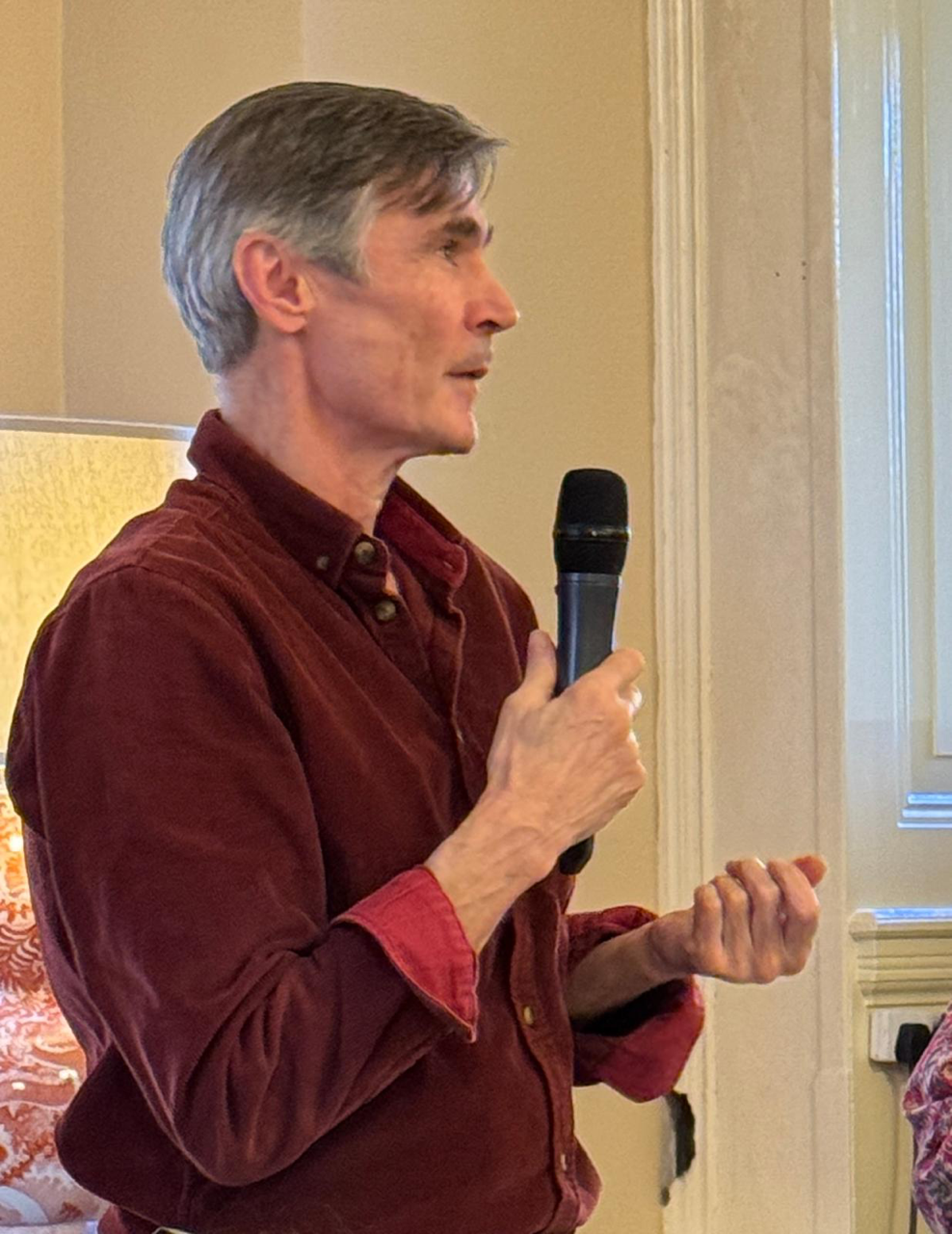 A few years ago, I read another novel by Andrew Miller, Pure, (2011) about a young engineer who comes to Paris just before the Revolution to exhume an ancient cemetery. It’s a brilliant novel and I’m very much looking forward to reading A Land in Winter. Andrew told us that his secret title for the novel while he was writing it was Confusion: it tells the story of two couples, both of whom are expecting babies, who become involved with each other in various ways. As Rachel Seiffert said when reviewing this novel in the Guardian: “Each figure Miller conjures is far more than the sum of its parts.” Like all really good novelists, Andrew Miller shows us the inner lives of all his characters, what Yeats called “the foul rag-and-bone shop of the heart.” Lucy asked him if one of the main characters, the young GP Eric Parry, was based on his father who was also a GP. Andrew replied that he couldn’t have written it while his father was alive.
He told us that he wanted to get all the characters together in one scene, so he wrote a long chapter, central to the novel, about a Boxing Day party. When Lucy asked him if he writes for any particular reader he replied, “I write for my best readers,” and added that his first draft of a novel is too pared back and doesn’t make much sense. The novel has been praised for its evocation of the early 60s, when the war was still a vivid presence, conscription to National Service had just ended, young people were beginning to question authority and were, he believes, more optimistic about the future than most young people are nowadays. His novel is dedicated “to musicians,” because he loves music and the people who make it and is himself an amateur musician.
Miranda Miller
www.mirandamiller.info