By C. J. Schuler
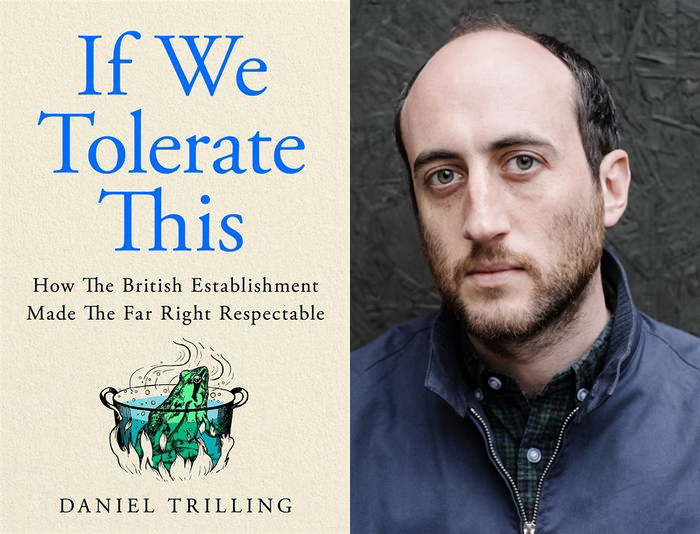
It seemed mordantly appropriate that we welcomed Daniel Trilling to the Authors’ Club to discuss his latest book If We Tolerate This: How the British Establishment Made the Far Right Respectable exactly a week after Reform UK’s gains in the local elections. Trilling has written about nationalism, migration and human rights for publications including the London Review of Books, the Guardian and the New York Times. His first book, Bloody Nasty People: The Rise of Britain’s Far Right, was longlisted for the 2013 Orwell Prize. His second, Lights in the Distance: Exile and Refuge at the Borders of Europe, won Italy’s Libri Contro la Fame prize and was shortlisted for the 2019 Bread and Roses Award.
His short, sharp and timely new book charts the way political ideas once confined to an extremist fringe have entered the mainstream. ‘When I started as a reporter following this story,’ he recalled, ‘the BNP were a small but alarming presence in local government in England. In the 15 years since then, I’ve been able to track this process of some of what was then restricted to the fringes of politics going completely mainstream and other parts staying on the fringes. I think what’s happened over that time is that the core themes that were once the preserve of extreme right-wing political groups have been taken up by a much wider range of people.’
Trilling referred to the work of the Dutch political scientist Cas Mudde, who divides the far right into two wings, one of which – Trilling explains – he calls the extreme right, that reject the very essence of democracy, and seek to replace it with a form of dictatorship. The other is the radical right, which we are now used to calling right-wing populism, comprising parties and politicians who accept the essence of democracy and mostly abide by election results (‘Trump excepted,’ Trilling added). ‘They often claim they’re more democratic than their opponents, but are uniformly hostile to certain elements of liberal democracy, criticising the judiciary, denouncing the press as liars – and when they actually get into positions of power they try to suppress the free media and stuff the courts with people who are politically on their side.’
Trilling traces the rise of the far right in the UK to the discontent and loss of community cohesion created by four decades of neoliberal economics, exacerbated by the 2008 financial crash, 14 years of Conservative-led austerity, and the Covid pandemic. The far right, of course, like to blame the social and economic problems people are experiencing on immigration. They thrive on stoking fears of ‘some sort of existential threat to the nation, the national community…’ He pointed out that both Labour and Conservative governments have attempted to assuage such fears by promising draconian restrictions of immigration.
In the late 1970s, with the National Front winning support, Margaret Thatcher ‘actually said that they might be swamped by immigration from other cultures.’ In 2007 Gordon Brown promised to deport foreign national offenders after they completed their prison sentences. ‘Then [Home Secretary] John Reid came in and split the Home Office in two, and gave the UK Border Agency uniforms to make them police officers to project this idea of security.’ In 2010 David Cameron said a Conservative government if elected would reduce net migration to the tens of thousands at a time when it was about 250,000 to 300,000 per year. In 2012, the then Home Secretary Theresa May pledged to create a ‘hostile environment’ for illegal migrants. ‘After Brexit the Tory party turned on itself and politics became more polarized,’ and Johnson, Truss and Sunak doubled down with a doomed plan to deport immigrants to Rwanda.
But they faced a double bind, Trilling explained. ‘The 14 years of Conservative-led government we’ve had since 2010 structurally requires migration, but plays mood music to indicate that they really disapprove of it and will do something about it and make sure they’re on the side of the voters who are unhappy about it and, I should also say, the side of the much more powerful and influential right wing press… By the time the Conservatives lost power 2024, their main contribution was to have made it kind of mainstream and almost unremarkable that ministers could talk about refugees as invaders and use rhetoric only a few years previously would have been highly controversial.’
Now, however, they have been outflanked on the right by Reform UK, deploying the very rhetoric which they themselves have legitimised. ‘The common thing the British far-right has claimed going back decades is that the political classes conspired to introduce immigration in a way that undermines, depending on your particular flavour of far-right politics, the white race, British national identity, cultural cohesion and so on.’
Of Nigel Farage, he remarked that ‘interestingly, as a former city trader he profited from both the neoliberal boom and what followed.’ He was ‘the symptom of the problem presenting itself as the cure.’
Despite the book’s wealth of detail, Trilling explains that it ‘is not a survey of everything there is to know and say about far-right politics even in Britain. What it is, is my attempt help readers understand why we have had this quite rapid and alarming development in the last few years… What I tried to do in the book was just boil it down to the essentials that I thought a general reader would need to understand what’s happening, and why.’
If We Tolerate This: How the British Establishment Made the Far Right Respectable by Daniel Trilling is published by Picador at £14.99.